Showing posts with label Miami-Dade. Show all posts

Dec 14, 2016

CDC Declares Florida Zika-Free


The Centers for Disease Control and Prevention (CDC) has declared Florida to be free of the Zika virus, but emphasized the need for caution.

The CDC noted, "There have been no new cases of local Zika virus transmission identified in South Miami Beach for more than 45 days, suggesting that the risk of Zika virus infection is no longer greater than in the rest of Miami-Dade County."

Miami-Dade County continues to carry a yellow area designation, meaning it's a cautionary area. Pregnant women in Miami-Dade County remain eligible for Zika virus testing.

CDC Director Dr. Tom Frieden praised Florida's rapid response and comprehensive mosquito control program for interrupting Zika transmission, but noted that "... we must stay vigilant and also take what we have learned and be prepared for next season."

As of December 8, a total of 4,575 cases of Zika had been reported in the continental United States and Hawaii, according to CDC. These cases include 185 locally transmitted mosquito-borne cases in Florida, 38 cases believed to be the result of sexual transmission, and one case that was the result of a laboratory exposure.

While Florida has been declared Zika-free, the same cannot be said for all U.S. states. Texas just confirmed four new local cases.
 

Jul 20, 2016

Florida DOH Investigating Possible Non-Travel Related Case of Zika


The Florida Department of Health (DOH) has announced it is conducting an investigation into a possible non-travel related case of Zika virus in Miami-Dade County.

If confirmed, this would be the first reported non-travel associated case. As of July 13, there more than 1,300 travel-associated cases reported in U.S. states.

As news reports note, the Florida DOH is considering all known routes of transmission, including the possibility that it still could be travel related.

For a roundup of some of other the most significant Zika news from the past week, read this Zika update.


Feb 5, 2016

Florida Gov. Scott Declares Zika Virus Emergency in Multiple Counties


Florida Gov. Rick Scott has declared a public health emergency in five Florida counties due to the Zika virus.

The counties, as of February 5, are as follows:
  • Broward
  • Miami-Dade
  • Hillsborough
  • Lee
  • Santa Rosa

To date, Florida has confirmed nine travel-related cases of the Zika virus, none of which have been pregnant women.

Zika is spread to people through mosquito bites. This is the same mosquito — from the Aedes genus, mainly Aedes aegypti in tropical regions — that transmits dengue, chikungunya and yellow fever. Aedes mosquitos are common in Florida.

The most common symptoms of Zika are fever, rash, joint pain, and conjunctivitis. They usually last 2-7 days. Severe disease requiring hospitalization is uncommon. However, an outbreak in South America has led to reports of Guillain-Barre syndrome and pregnant women giving birth to babies with birth defects and poor pregnancy outcomes.

Gov. Scott has requested that the Centers for Disease Control and Prevention (CDC) provide at least 1,000 Zika antibody tests (Florida currently has the capacity to test only 475 people.) The antibody test allows the state to see if individuals ever had the Zika virus. Gov. Scott has also requested that the CDC conduct a conference call to help train Florida hospital workers — especially OB/GYN physicians and those who work with pregnant women — on how Zika is spread, its symptoms, treatments and proper precautions.

No vaccine exists to prevent Zika. The best method of prevention is to avoid mosquito bites. Help reduce the number of mosquitoes inside and outside your home or hotel room by emptying standing water from containers such as flowerpots or buckets.

Healthcare providers are encouraged to report suspected Zika cases to their state health department to facilitate diagnosis and mitigate risk of local transmission.

Phenelle Segal of Florida-based Infection Control Consulting Services provides infection control and infection prevention education and services to a variety of healthcare facilities and organizations including, but not limited, to hospitals and health systems, ambulatory surgery centers, physicians practices, dentists and nursing homes. Services include accreditation survey preparation, infection prevention risk assessment, development of infection prevention programs, infection prevention training and much more. Contact Phenelle Segal by clicking here.
 

Apr 1, 2015

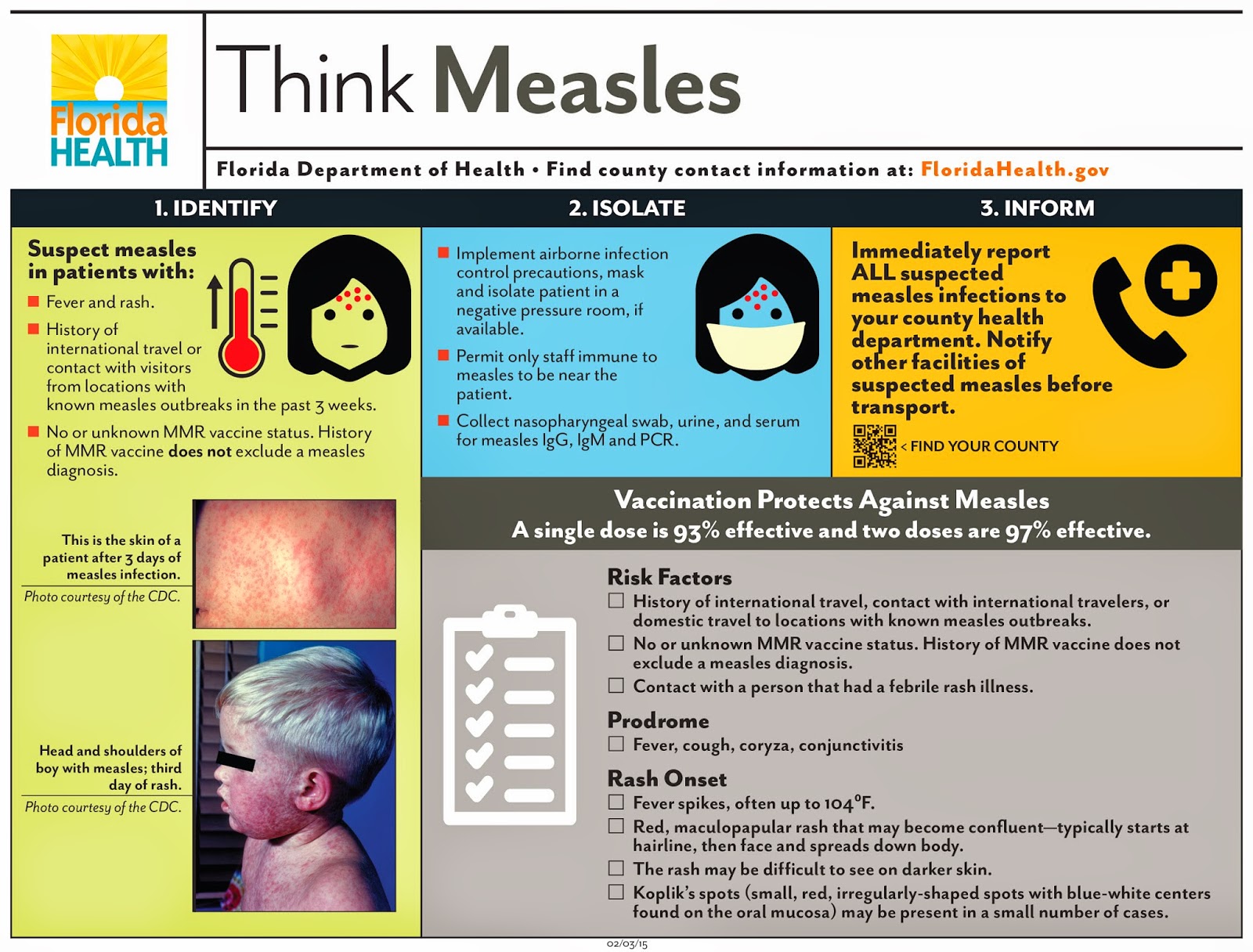
Health Officials Confirm Case of Measles in Florida


The Florida Department of Health has confirmed the state's first case of measles this year in an international traveler became ill while on a business trip.

The infected person was attending a conference in Kissimmee for two days but did not attend any theme parks. While he mainly spent time at the conference in Osceola County, he also spent time in Miami-Dade, Orange and Sarasota counties.

The traveler was hospitalized between March 20-24 in Miami and after recovery left Florida by plane on March 25. Emergency rooms in the areas that he visited during the incubation period are aware of the case and are watching for other suspected cases.

Measles is one of the most contagious communicable diseases that spreads via the respiratory/droplet route. It has resurfaced this year, with four outbreaks in 17 States and the District of Columbia, and a reported 178 people with the disease as of March 27, according to the Centers for Disease Control and Prevention (CDC). The primary case is thought to be an international traveler who visited Disneyland in California.

Parents of unvaccinated children as well as unvaccinated adults born after 1957 should be quarantined for 21 days after a known or suspected exposure to someone with measles. With the surge of cases since the beginning of the year, the push to promote vaccination, particularly in children, is in full swing.

Unfortunately, unfounded, non-scientific based information regarding childhood vaccines causing autism and other disorders has increased the exposure risk of individuals who are unable to be vaccinated for medical reasons and is resulting in the loss of community immunity.

Healthcare professionals should suspect measles in unvaccinated patients with the following signs and symptoms:
  • Fever
  • Dry cough
  • Runny nose
  • Sore throat
  • Inflamed eyes (conjunctivitis) and sensitivity to light (photophobia)
  • Tiny white spots with bluish-white centers on a red background found inside the mouth on the inner lining of the cheek — also called Koplik's spots
  • A skin rash made up of large, flat blotches that often flow into one another

Jan 5, 2015

Hospital-Acquired Infections in Florida: CDC Data


The federal government has gained strength over the years in promoting transparency within hospitals with respect to many patient safety factors that include prevention of infections. Mandates for public reporting have been in effect for several years nationwide and the Centers for Disease Control and Prevention (CDC) has the responsibility for tracking six frequently occurring healthcare-acquired infections including, but not limited to, certain surgical site infections (resulting from colon and hysterectomy operations), central line-associated bloodstream infections and catheter-associated urinary tract infections. One in 25 patients develops an infection while receiving inpatient care and one in nine patients who develop an infection will die.

A December column in the Miami Herald reported that "The CDC collected the data on infections from 4,683 hospitals around the country, including 179 in Florida, between October 2012 and September 2013." The article highlights that seven Miami-Dade hospitals fell below national standards for combating infections acquired by patients in hospitals, and patients at one hospital in Miami were more likely to develop infections than patients at any other hospital in South Florida, according to the data. This hospital did worse than benchmarked hospitals in four different categories of healthcare-acquired infections. Only one other hospital in Northern Florida, a teaching hospital, underperformed in more than two categories, and a total of only seven hospitals in the nation underperformed in four categories.

The article notes that "As a whole, Florida hospitals are performing significantly better than national benchmarks in three areas: bloodstream, urinary tract and colon infections, according to CDC data released in March."

A representative from the Florida Hospital Association, a trade group, added that overall, "hospitals in the state were working together to find effective strategies for reducing infections and other hospital-related injuries like falls and medication overdoses. Patients and providers would benefit from focusing on the problems because hospitals have higher treatment costs when patients develop complications under their care."


To read the Miami Herald's in-depth report, access the column by clicking here.