Showing posts with label Florida Department of Health. Show all posts

Jul 20, 2016

Florida DOH Investigating Possible Non-Travel Related Case of Zika


The Florida Department of Health (DOH) has announced it is conducting an investigation into a possible non-travel related case of Zika virus in Miami-Dade County.

If confirmed, this would be the first reported non-travel associated case. As of July 13, there more than 1,300 travel-associated cases reported in U.S. states.

As news reports note, the Florida DOH is considering all known routes of transmission, including the possibility that it still could be travel related.

For a roundup of some of other the most significant Zika news from the past week, read this Zika update.


Nov 2, 2015

Palm Beach County Schoolboy Succumbs to Bacterial Meningitis


Each year, approximately 500 people die from bacterial meningitis, which often results in a fatal outcome. If patients survive the illness, it can often leave them with serious complications such as hearing loss and brain damage. These diseases tend to spread more quickly where larger groups of people gather together. College students living in residence halls and military personnel are at increased risk for bacterial infections such as meningococcal meningitis (caused by Neisseria meningitidis).

A five-year-old Palm Beach County resident is the latest victim in Florida to die after developing meningitis. This is causing concern among the school community. The Florida Department of Health began administering prophylactic antibiotics shortly after the diagnosis was confirmed. These antibiotics are very effective in preventing the spread of the illness to others.

Public school students in Palm Beach County are not required to be vaccinated for bacterial meningitis, but the health department recommends children receive the vaccine. The Immunization Action Coalition, a non-profit that advocates for increased immunization rates, reports that at least 22 states and Washington, D.C., require students to receive the vaccine (meningococcal).

In 2014, a high school senior in Lakeland, Florida, died of complications from the illness, and a case was reported at an elementary school in Miramar in 2013.

Health officials will closely monitor children and staff at the hospital in Palm Beach County. Concerned families can contact officials for advice.
 

Oct 13, 2015

Central Florida Man Dies From Vibrio Vulnificus Bacteria Infection


A 56-year-old resident of Winter Haven is the latest Floridian to die from the Vibrio vulnificus bacteria, according to local media reports, including TCPalm.

The victim contracted the disease after he want saltwater fishing. He was dead from the bacterial infection in three days.

As the Florida Department of Health  notes, Vibrio vulnificus is a bacterium that normally lives in warm seawater. It is part of a group of vibrios that are called "halophilic" because they require salt. Vibrio vulnificus is a naturally occurring bacteria in warm, brackish seawater.

While Vibrio vulnificus infections are rare, it has been responsible for at least a dozen deaths in 2015.

The Florida Department of Health  provides the following tips for preventing Vibrio vulnificus infections:
  • Do not eat raw oysters or other raw shellfish.
  • Cook shellfish (oysters, clams, mussels) thoroughly.
  • For shellfish in the shell, either a) boil until the shells open and continue boiling for five more minutes, or b) steam until the shells open and then continue cooking for nine more minutes. Do not eat those shellfish that do not open during cooking. Boil shucked oysters at least three minutes, or fry them in oil at least 10 minutes at 375°F.
  • Avoid cross-contamination of cooked seafood and other foods with raw seafood and juices from raw seafood.
  • Eat shellfish promptly after cooking and refrigerate leftovers.
  • Avoid exposure of open wounds or broken skin to warm salt or brackish water, or to raw shellfish harvested from such waters.
  • Wear protective clothing (e.g., gloves) when handling raw shellfish.

Jul 8, 2015

New Study: Fish Poisoning in Florida Underreported


A new study conducted by the University of Florida’s Emerging Pathogens Institute and the Florida Department of Health (DOH) found the number of people in Florida sickened by a dangerous food-borne toxin carried by popular sport fish may be more common than previously reported.

The toxin is called ciguatera. Symptoms associated with it may include vomiting, diarrhea, stomach pain or cramping; itchy skin; aching teeth, muscles, or joints; tingling sensation in the extremities; painful urination; and temperature reversal with a typical onset within 24 hours following fish consumption. Gastrointestinal symptoms typically present first, within 24 hours of exposure, followed by neurological symptoms which usually begin 1-2 days following the exposure.

The Florida DOH reports that over 400 known fish species have been classified as potential ciguatoxin carriers. Examples of species associated with Florida cases include barracuda, grouper, amberjack, snapper, tuna, kingfish, eel, trevally, seabass, mackerel, hogfish, and mahi-mahi. Cooking fish does not kill the heat-stable toxin, and ciguatoxic fish do not carry a foul odor or taste.

The study, published in the American Journal of Tropical Medicine and Hygiene, found that Florida's annual incidence of ciguatera poisoning is estimated at about 5.6 cases per 100,000 people, almost 30 times higher than previous estimates of 0.2 cases per 100,000.

As a press release from the Emerging Pathogens Institute notes, "The findings reaffirm pre-existing warnings to avoid eating barracuda. But the data indicate that in Florida, grouper, amberjack, hogfish, snapper, mackerel and mahi mahi harvested in tropical and subtropical areas were also associated with illness."

The Florida DOH notes that is possible to reduce your risk of ciguatera. Avoid eating large fish or species that have been reported to carry ciguatera. Ask local fishermen or bait shops for the reefs and types of fish to avoid. Unfortunately, there is no approved test kit for ciguatera at this time. At first sign of illness, contact your doctor or local emergency room and report your symptoms and what fish you ate. You can also call the toll-free Poison Help Hotline at (800) 222-1222 for more information on this marine toxin.

To read 10 facts to know about ciguatera fish poisoning assembled by the Florida DOH, click here.

Jun 24, 2015

Warning to Florida Beachgoers: Watch Out for Vibrio Vulnificus Infections


The Florida Department of Health (DOH) is reminding visitors to the state's beaches to take proper precautions to reduce the risk of contracting infections due to the Vibrio vulnificus bacterium.

The DOH stated that there have been eight reported cases of Vibrio vulnificus infections in 2015 through June 12, which include two deaths.

According to the DOH, Vibrio vulnificus is a bacterium that normally lives in warm seawater and is part of a group of vibrios that are called 'halophilic' because they require salt. It is a naturally occurring bacteria in warm, brackish seawater, and infections are rare.

According to an online resource about Vibrio vulnificus developed by the DOH, people can become infected with Vibrio vulnificus when they eat raw shellfish, particularly oysters. The bacterium is frequently isolated from oysters and other shellfish in warm coastal waters during the summer months. Since it is naturally found in warm marine waters, people with open wounds can be exposed to Vibrio vulnificus through direct contact with seawater. The infection is diagnosed by stool, wound, or blood cultures. There is no evidence of person-to-person transmission of Vibrio vulnificus.

According to the Centers for Disease Control and Prevention (CDC), among healthy people, ingestion of Vibrio vulnificus can cause vomiting, diarrhea and abdominal pain. In immunocompromised persons, particularly those with chronic liver disease, Vibrio vulnificus can infect the bloodstream, causing a severe and life-threatening illness characterized by fever and chills, decreased blood pressure (septic shock) and blistering skin lesions. Vibrio vulnificus bloodstream infections are fatal about 50% of the time.

There are a number of cooking-related tips for preventing Vibrio vulnificus infections, including not eating raw oysters or other raw shellfish, and wearing protective clothing (e.g., gloves) when handling raw shellfish. For beachgoers, the DOH recommends the following:
  • Avoid exposure of open wounds or broken skin to warm salt or brackish water, or to raw shellfish harvested from such waters.
  • Individuals who are immunocompromised (e.g., chronic liver disease, kidney disease, weakened immune system) should wear proper foot protection to prevent cuts and injury caused by rocks and shells on the beach.
Healthcare professionals are advised to have a high suspicion for this organism when patients present with stomach illness, fever or shock following the ingestion of raw seafood, especially oysters, or with a wound infection after exposure to seawater. If Vibrio vulnificus is suspected, treatment should be initiated immediately because antibiotics improve survival. Aggressive attention should be given to the wound site; for patients with wound infections, amputation of the infected limb is sometimes necessary.

Apr 22, 2015

New Confirmed Cases of Measles in Florida


Three new cases of measles have been reported in the last few days to the Florida Department of Health. The three cases are located on the Treasure Coast: two in Indian River County and one in St. Lucie County.

The index case, an adult in Indian River County-Vero Beach, is thought to have acquired measles during overseas travel and spread it to a family member in the same house. The St. Lucie County-Port St. Lucie case is a 6-year-old child who was previously unvaccinated. The Florida Department of Health is working with the specific school district in St. Lucie County to notify families of this highly transmissible disease.

These new cases of measles have health officials concerned. They come just a few weeks after an isolated case was reported when an international traveler became ill at a conference in Kissimmee. No new cases had resulted in Florida that could be attributed to that foreign traveler.  

Specific vaccination guidelines are available for unvaccinated adults and children. In an effort to implement effective infection control efforts, it is recommended that children be immunized against measles between 12 and 15 months and again at 4 to 6 years.

Apr 1, 2015

Health Officials Confirm Case of Measles in Florida


The Florida Department of Health has confirmed the state's first case of measles this year in an international traveler became ill while on a business trip.

The infected person was attending a conference in Kissimmee for two days but did not attend any theme parks. While he mainly spent time at the conference in Osceola County, he also spent time in Miami-Dade, Orange and Sarasota counties.

The traveler was hospitalized between March 20-24 in Miami and after recovery left Florida by plane on March 25. Emergency rooms in the areas that he visited during the incubation period are aware of the case and are watching for other suspected cases.

Measles is one of the most contagious communicable diseases that spreads via the respiratory/droplet route. It has resurfaced this year, with four outbreaks in 17 States and the District of Columbia, and a reported 178 people with the disease as of March 27, according to the Centers for Disease Control and Prevention (CDC). The primary case is thought to be an international traveler who visited Disneyland in California.

Parents of unvaccinated children as well as unvaccinated adults born after 1957 should be quarantined for 21 days after a known or suspected exposure to someone with measles. With the surge of cases since the beginning of the year, the push to promote vaccination, particularly in children, is in full swing.

Unfortunately, unfounded, non-scientific based information regarding childhood vaccines causing autism and other disorders has increased the exposure risk of individuals who are unable to be vaccinated for medical reasons and is resulting in the loss of community immunity.

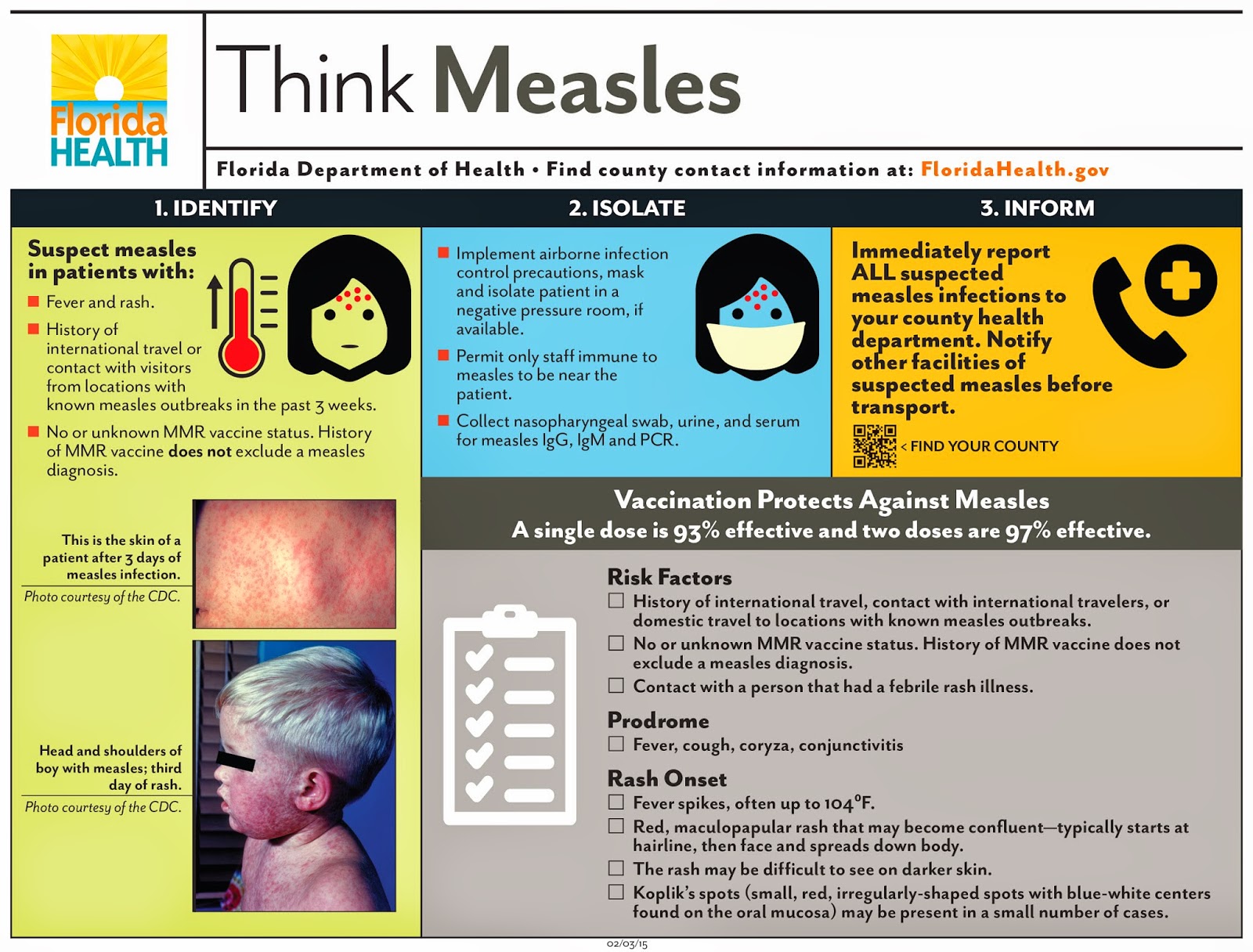
Healthcare professionals should suspect measles in unvaccinated patients with the following signs and symptoms:
  • Fever
  • Dry cough
  • Runny nose
  • Sore throat
  • Inflamed eyes (conjunctivitis) and sensitivity to light (photophobia)
  • Tiny white spots with bluish-white centers on a red background found inside the mouth on the inner lining of the cheek — also called Koplik's spots
  • A skin rash made up of large, flat blotches that often flow into one another