Showing posts with label Florida. Show all posts

Jul 2, 2018

Floridian First Human to Contract Keystone Virus


A Florida teenager is the first person on record to have contracted the Keystone virus, according to a report published in this month's Clinical Infectious Diseases journal and coverage by multiple news outlets.

Previously only found in animals, the Keystone virus is spread by mosquito, specifically the aedes atlanticus. The virus was identified in the 16-year-old teenage boy following a visit to a North Central Florida urgent care clinic in 2016.

Physicians initially thought the teen's fever and rash was caused by Zika, but researchers from the University of Florida eventually found the Keystone virus in patient samples.

Lab studies indicate that the Keystone virus can infect brain cells and may pose a brain infection risk.

Researchers suspect that the Keystone virus has likely infected humans for many years, specifically in North Florida. Until now there was no way to test for the virus and symptoms associated with the virus were likely mild.

The Keystone virus is named after the Florida town where it was first identified in 1964.


Apr 2, 2018

Infection Prevention Expert Phenelle Segal to Present at Florida Society of ASCs' 2018 Quality & Risk Management Conference


Phenelle Segal, RN, CIC, FAPIC, founder of Florida-based Infection Control Consulting Services (ICCS), will present at the 2018 Florida Society of Ambulatory Surgical Centers' (FSASC) Quality & Risk Management Conference.

The FSASC conference is scheduled for April 19-20 at the Renaissance Orlando at SeaWorld.

Segal, an FSASC member, is scheduled to present on Thursday, April 19, from 10:45 a.m. – 12:15 p.m. Her topic is "Infection Prevention Update – Guideline for the Prevention of Surgical Site Infection."

The description of her session is as follows: "This year highlights a major update of the 1998 'Guideline for the Prevention of Surgical Site Infection' and includes strategies that are important in the outpatient setting as well as inpatient. The presentation will also include antimicrobial stewardship as it pertains to the ASC setting."

This annual FSASC meeting focuses solely on the development of superior quality outcomes in ASCs and reducing the risks present in patient encounters. The mission of FSASC is to "...advance the ASC industry through community awareness and government advocacy and to promote the professionalism of its members through education, networking and the exchange of information."

To arrange an on-site meeting in Orlando or schedule a phone consultation with Phenelle, contact ICCS.

About Infection Control Consulting Services (ICCS)

ICCS is a provider of infection prevention and infection control services headquartered in Florida. Serving ambulatory surgery centers, hospitals, outpatient care facilities, dentists and all other healthcare organizations in Florida and throughout the country, ICCS services include assistance with accreditation survey preparation and regulatory requirements, on-site facility visits, preparation of and assistance with corrective plans of action related to survey deficiencies, and infection preventionist mentoring and onboarding.
 

Aug 3, 2017

Florida Confirms First Sexually Transmitted Case of Zika in 2017


The Florida Department of Health (DOH) has announced it has confirmed the first sexually transmitted Zika case in 2017.

The case was confirmed in Pinellas County. The DOH reported that the individual's partner recently traveled to Cuba and had fallen ill with symptoms consistent with Zika. Both tested positive for Zika. The virus can remain in semen for months after infection, even without symptoms, and can be spread to partners during that period of time.

Following confirmation, the DOH stated it notified mosquito control, which is rolling out mosquito reduction activities.

Zika infection during pregnancy can cause a serious birth defect called microcephaly, which is a sign of incomplete brain development. Physicians have identified other problems in pregnancies and among fetuses and infants infected with Zika virus before birth.

There is no evidence of ongoing transmission of Zika by mosquitoes in any area of Florida at this time.

As of August 1, the total number of Zika cases reported in Florida in 2017, which is broken down as follows:
  • Travel-related Infections of Zika — 90
  • Locally acquired infections exposed in 2016, tested in 2017 — 6
  • Undetermined exposed in 2016, tested in 2017 — 22
For five things you should know about Zika, according the Centers for Disease Control and Prevention, click here.
 

Dec 14, 2016

CDC Declares Florida Zika-Free


The Centers for Disease Control and Prevention (CDC) has declared Florida to be free of the Zika virus, but emphasized the need for caution.

The CDC noted, "There have been no new cases of local Zika virus transmission identified in South Miami Beach for more than 45 days, suggesting that the risk of Zika virus infection is no longer greater than in the rest of Miami-Dade County."

Miami-Dade County continues to carry a yellow area designation, meaning it's a cautionary area. Pregnant women in Miami-Dade County remain eligible for Zika virus testing.

CDC Director Dr. Tom Frieden praised Florida's rapid response and comprehensive mosquito control program for interrupting Zika transmission, but noted that "... we must stay vigilant and also take what we have learned and be prepared for next season."

As of December 8, a total of 4,575 cases of Zika had been reported in the continental United States and Hawaii, according to CDC. These cases include 185 locally transmitted mosquito-borne cases in Florida, 38 cases believed to be the result of sexual transmission, and one case that was the result of a laboratory exposure.

While Florida has been declared Zika-free, the same cannot be said for all U.S. states. Texas just confirmed four new local cases.
 

Nov 17, 2016

CDC Identifies Antimicrobial Stewardship Program for University of Miami and Jackson Memorial Hospitals as Model


The week of November 14-20, 2016, has been designated by the Centers for Disease Control and Prevention (CDC) as "Get Smart About Antibiotics Week." This annual one-week observance is intended to raise awareness of antibiotic resistance and the importance of appropriate antibiotic prescribing and use.

As the CDC reports, at least 30% of antibiotics prescribed in hospital clinic, doctor's offices and emergency departments are unnecessary. This equates to 47 million unnecessary prescriptions written in those settings. Each year in the United States, at least 2 million people become infected with bacteria resistant to antibiotics and at least 23,000 people die as a direct result of the infections.

Such statistics emphasize the need for organizations to develop and maintain antimicrobial stewardship (AMS) programs. As of 2015, about 50% of all hospitals had instituted an AMS program. The White House issued a "National Action Plan to Combat Antibiotic-Resistant Bacteria" in 2015, which included a goal of 100% of hospitals establishing an AMS program by 2020.

CDC provides links to a few websites of hospital AMS programs throughout the country to serve as examples intended to assist organizations with developing their own AMS programs. Included is a link to the AMS program website for the University of Miami and Jackson Memorial Hospitals.

The program is named "GotaBug." The following are steps the program advises hospital staff members to take to help reduce antimicrobial resistance:
  • Take an antibiotic "Time Out" as part of your daily rounds
  • Reassess antimicrobial therapy based on cultures and susceptibilities
  • Pick the correct drug, dose and duration
  • De-escalate broad spectrum antimicrobials whenever possible
  • Stop antimicrobials when no longer needed
  • Get your annual flu shots
  • Wash your hands

Florida-based infection control consultant Phenelle Segal, RN, CIC, president and founder of Infection Control Consulting Services (ICCS), and the ICCS team of consultants assist healthcare organizations with the development of AMS programs as part of their ongoing effort to preventing infections. To learn about how ICCS can help your organization, contact ICCS.
 

Oct 31, 2016

The Role of Personal Protective Equipment in Infection Prevention History


Phenelle Segal, RN, CIC, president of Infection Control Consulting Services (ICCS), has contributed a new column to Infection Control Today on personal protective equipment (PPE).

Topics discussed in the column include:
  • Early uses of PPE
  • Guidelines concerning their use
  • PPE in the 21st century
  • Evolution of PPE across the continuum of care
  • Special circumstances for PPE use, specifically Ebola
  • Recent controversies in the surgery setting concerning proper surgical attire

To access the article, click here.

ICCS is a Florida-based provider of infection control consulting for surgery centers, dental offices and many other types of healthcare organizations. Services provided by the ICCS team, led by Phenelle, including developing, implementing and maintaining evidence-based infection prevention and control programs as well as providing educational programs to meet client needs.
 

Oct 26, 2016

Zika Virus Detected in Blood Donated in Florida


Blood donated and screened in Florida has tested positive for the Zika virus, according to multiple news reports.

This is the only positive Florida test result for donated blood to date. The donation never entered the blood supply.

OneBlood, a blood center serving most of Florida and parts of other states, has tested a sample of every Florida donor's blood for several months.

The American Red Cross announced earlier in the year that it was also conducting blood donor screening.

In its October 24 Zika update, the Florida Department of Health provided the following breakdown of non-travel and travel-related Zika infections to-date in the state:
  • Travel-related infections of Zika — 752
  • Non-travel-related infections of Zika — 169
  • Infections involving pregnant women — 113
  • Out-of-state cases (not Florida residents) — 19
  • Undetermined — 5
  • Total — 1,058
In August, the U.S. Food & Drug Administration recommended universal testing of donated whole blood and blood components for Zika virus in the United States and its territories.
 

Aug 22, 2016

Zika Virus Spreads to Miami Beach, Prompting Warnings


As the fear of Zika virus infections continues to plague Florida, the Centers for Disease Control and Prevention (CDC) announced on August 19 that "pregnant women should not travel to an area of Miami Beach where local Zika virus transmission has been confirmed."

This is the second area in Miami that has been identified as being "at risk" for active transmission of the virus. The Florida Department of Health announced that five locally transmitted cases have been confirmed as connected to the Miami Beach area.

The CDC further advised that the sexual partners of pregnant women refrain from visiting the area. Pregnant women are at the highest risk due to identification of birth defects in babies born to mothers who have contracted the illness. As Dr. Tom Frieden, CDC director, states, "The risk is low, but the outcome is so horrific, you really want to try to avoid it."

Florida Governor Rick Scott noted, "There are 36 locally transmitted cases of the virus and 20.6 million people living in the state," requesting that the public put this issue in perspective. 

The CDC is aiding Florida with test and prevention kits to assist with transmission identification and prevention.
 

Jul 20, 2016

Florida DOH Investigating Possible Non-Travel Related Case of Zika


The Florida Department of Health (DOH) has announced it is conducting an investigation into a possible non-travel related case of Zika virus in Miami-Dade County.

If confirmed, this would be the first reported non-travel associated case. As of July 13, there more than 1,300 travel-associated cases reported in U.S. states.

As news reports note, the Florida DOH is considering all known routes of transmission, including the possibility that it still could be travel related.

For a roundup of some of other the most significant Zika news from the past week, read this Zika update.


Jun 28, 2016

Florida DOH Confirms State's First Zika-Related Case of Microcephaly


The Florida Department of Health (DOH) confirmed the first Zika virus-related case of microcephaly in a child born in Florida.

Microcephaly is a birth defect where a baby's head is smaller than expected when compared to babies of the same sex and age. Babies with microcephaly often have smaller brains that might not have developed properly. This could contribute to a wide range of problems, including developmental delay, intellectual disability, problems with movement and balance, hearing loss and vision problems.

The mother of the child with microcephaly isa citizen of Haiti who had a travel-related case of Zika. She came to Florida to deliver her baby.

Florida Governor Rick Scott has taken the Zika threat very seriously. In February, he directed the state surgeon general to issue a declaration of public health emergency for the counties of residents with travel-associated cases of Zika and activate a Zika virus information hotline for current Florida residents and visitors, as well as anyone planning on traveling to Florida in the near future.

Just last week, Scott announced he would use his emergency executive authority to allocate more than $26 million in state funds for Zika preparedness, prevention and response in Florida.

Florida has been monitoring pregnant women with evidence of Zika regardless of symptoms since January. The total number of pregnant women who have been monitored is 40, with 10 having met the previous Centers for Disease Control and Prevention case definition.
 

Feb 5, 2016

Florida Gov. Scott Declares Zika Virus Emergency in Multiple Counties


Florida Gov. Rick Scott has declared a public health emergency in five Florida counties due to the Zika virus.

The counties, as of February 5, are as follows:
  • Broward
  • Miami-Dade
  • Hillsborough
  • Lee
  • Santa Rosa

To date, Florida has confirmed nine travel-related cases of the Zika virus, none of which have been pregnant women.

Zika is spread to people through mosquito bites. This is the same mosquito — from the Aedes genus, mainly Aedes aegypti in tropical regions — that transmits dengue, chikungunya and yellow fever. Aedes mosquitos are common in Florida.

The most common symptoms of Zika are fever, rash, joint pain, and conjunctivitis. They usually last 2-7 days. Severe disease requiring hospitalization is uncommon. However, an outbreak in South America has led to reports of Guillain-Barre syndrome and pregnant women giving birth to babies with birth defects and poor pregnancy outcomes.

Gov. Scott has requested that the Centers for Disease Control and Prevention (CDC) provide at least 1,000 Zika antibody tests (Florida currently has the capacity to test only 475 people.) The antibody test allows the state to see if individuals ever had the Zika virus. Gov. Scott has also requested that the CDC conduct a conference call to help train Florida hospital workers — especially OB/GYN physicians and those who work with pregnant women — on how Zika is spread, its symptoms, treatments and proper precautions.

No vaccine exists to prevent Zika. The best method of prevention is to avoid mosquito bites. Help reduce the number of mosquitoes inside and outside your home or hotel room by emptying standing water from containers such as flowerpots or buckets.

Healthcare providers are encouraged to report suspected Zika cases to their state health department to facilitate diagnosis and mitigate risk of local transmission.

Phenelle Segal of Florida-based Infection Control Consulting Services provides infection control and infection prevention education and services to a variety of healthcare facilities and organizations including, but not limited, to hospitals and health systems, ambulatory surgery centers, physicians practices, dentists and nursing homes. Services include accreditation survey preparation, infection prevention risk assessment, development of infection prevention programs, infection prevention training and much more. Contact Phenelle Segal by clicking here.
 

Dec 10, 2015

"Kissing Bug" Disease Identified in Florida


The Centers for Disease Control and Prevention is warning Floridians about Chagas disease as recent reports indicate that Triatomine bugs, which can carry the disease, have invaded the southern United States, including Florida.

Triatomine bugs, also known as the "kissing bug," carry the parasite Trypanosoma cruzi that causes Chagas disease. These bugs are found primarily in the southern United States, Mexico, Central America and South America. The Centers for Disease Control and Prevention (CDC) reports that approximately 8 million people are infected with Chagas disease worldwide, mainly in South and Central America.

The reason for the nickname "kissing bug" is that bites most commonly occur around the mouth and face. People primarily become infected when the fecal matter of the triatomine bug carrying Chagas enters an open wound or bite. Not all triatomine bugs are infected with Chagas disease.

CDC suggests covering cracks, screening doors and windows, and removing wood and rock piles to prevent the bugs from gathering near or in homes. People with pets should note that if the kissing bug makes its way indoors, it will usually hide near the pet's resting area.
 

Nov 2, 2015

Palm Beach County Schoolboy Succumbs to Bacterial Meningitis


Each year, approximately 500 people die from bacterial meningitis, which often results in a fatal outcome. If patients survive the illness, it can often leave them with serious complications such as hearing loss and brain damage. These diseases tend to spread more quickly where larger groups of people gather together. College students living in residence halls and military personnel are at increased risk for bacterial infections such as meningococcal meningitis (caused by Neisseria meningitidis).

A five-year-old Palm Beach County resident is the latest victim in Florida to die after developing meningitis. This is causing concern among the school community. The Florida Department of Health began administering prophylactic antibiotics shortly after the diagnosis was confirmed. These antibiotics are very effective in preventing the spread of the illness to others.

Public school students in Palm Beach County are not required to be vaccinated for bacterial meningitis, but the health department recommends children receive the vaccine. The Immunization Action Coalition, a non-profit that advocates for increased immunization rates, reports that at least 22 states and Washington, D.C., require students to receive the vaccine (meningococcal).

In 2014, a high school senior in Lakeland, Florida, died of complications from the illness, and a case was reported at an elementary school in Miramar in 2013.

Health officials will closely monitor children and staff at the hospital in Palm Beach County. Concerned families can contact officials for advice.
 

Oct 13, 2015

Central Florida Man Dies From Vibrio Vulnificus Bacteria Infection


A 56-year-old resident of Winter Haven is the latest Floridian to die from the Vibrio vulnificus bacteria, according to local media reports, including TCPalm.

The victim contracted the disease after he want saltwater fishing. He was dead from the bacterial infection in three days.

As the Florida Department of Health  notes, Vibrio vulnificus is a bacterium that normally lives in warm seawater. It is part of a group of vibrios that are called "halophilic" because they require salt. Vibrio vulnificus is a naturally occurring bacteria in warm, brackish seawater.

While Vibrio vulnificus infections are rare, it has been responsible for at least a dozen deaths in 2015.

The Florida Department of Health  provides the following tips for preventing Vibrio vulnificus infections:
  • Do not eat raw oysters or other raw shellfish.
  • Cook shellfish (oysters, clams, mussels) thoroughly.
  • For shellfish in the shell, either a) boil until the shells open and continue boiling for five more minutes, or b) steam until the shells open and then continue cooking for nine more minutes. Do not eat those shellfish that do not open during cooking. Boil shucked oysters at least three minutes, or fry them in oil at least 10 minutes at 375°F.
  • Avoid cross-contamination of cooked seafood and other foods with raw seafood and juices from raw seafood.
  • Eat shellfish promptly after cooking and refrigerate leftovers.
  • Avoid exposure of open wounds or broken skin to warm salt or brackish water, or to raw shellfish harvested from such waters.
  • Wear protective clothing (e.g., gloves) when handling raw shellfish.

Jul 13, 2015

Chikungunya Virus: Are We Closer to a Vaccine?


As the summer progresses and over 40 species of mosquitoes take "residence" in Florida, the Chikungunya virus (CHIKV), which originated in the Caribbean, is once again a threat to persons who are susceptible to mosquito bites and unprotected when enjoying the outdoors.

Recently recognized and joining Dengue fever as a mosquito-borne illness, CHIKV symptoms range from mild to severe headaches, high fever, muscle pain, possible rash and, most notable, severe joint pains in the arms and legs that can be highly debilitating and prolonged. Patients describe feeling "so ill" that they can't get out of bed. It can take a toll on work productivity and activities of daily living.

To date, no vaccine or treatment is available, and the mechanism for protection has been difficult to grasp. But, according to Cell Host & Microbe, a group of scientists recently isolated human monoclonal antibodies (mAbs) from donors that neutralize CHIKV infectivity. Several of these mAbs exhibited prophylactic and therapeutic activity in a mouse model, suggesting hope for prevention of infection in the future with a vaccine.

While it is too soon to determine if a vaccine is possible, this discover provides a lead for scientists to continue studying the potential for providing protection to "at-risk" individuals. 

Jul 8, 2015

New Study: Fish Poisoning in Florida Underreported


A new study conducted by the University of Florida’s Emerging Pathogens Institute and the Florida Department of Health (DOH) found the number of people in Florida sickened by a dangerous food-borne toxin carried by popular sport fish may be more common than previously reported.

The toxin is called ciguatera. Symptoms associated with it may include vomiting, diarrhea, stomach pain or cramping; itchy skin; aching teeth, muscles, or joints; tingling sensation in the extremities; painful urination; and temperature reversal with a typical onset within 24 hours following fish consumption. Gastrointestinal symptoms typically present first, within 24 hours of exposure, followed by neurological symptoms which usually begin 1-2 days following the exposure.

The Florida DOH reports that over 400 known fish species have been classified as potential ciguatoxin carriers. Examples of species associated with Florida cases include barracuda, grouper, amberjack, snapper, tuna, kingfish, eel, trevally, seabass, mackerel, hogfish, and mahi-mahi. Cooking fish does not kill the heat-stable toxin, and ciguatoxic fish do not carry a foul odor or taste.

The study, published in the American Journal of Tropical Medicine and Hygiene, found that Florida's annual incidence of ciguatera poisoning is estimated at about 5.6 cases per 100,000 people, almost 30 times higher than previous estimates of 0.2 cases per 100,000.

As a press release from the Emerging Pathogens Institute notes, "The findings reaffirm pre-existing warnings to avoid eating barracuda. But the data indicate that in Florida, grouper, amberjack, hogfish, snapper, mackerel and mahi mahi harvested in tropical and subtropical areas were also associated with illness."

The Florida DOH notes that is possible to reduce your risk of ciguatera. Avoid eating large fish or species that have been reported to carry ciguatera. Ask local fishermen or bait shops for the reefs and types of fish to avoid. Unfortunately, there is no approved test kit for ciguatera at this time. At first sign of illness, contact your doctor or local emergency room and report your symptoms and what fish you ate. You can also call the toll-free Poison Help Hotline at (800) 222-1222 for more information on this marine toxin.

To read 10 facts to know about ciguatera fish poisoning assembled by the Florida DOH, click here.

Jun 30, 2015

Florida Struggles With Growing Number of HIV Infections


Florida is experiencing a significant growth in HIV infection cases, according to a Florida Department of Health report (pdf).

In 2012, the number of reported cases was 4,512, well below the more than 7,800 reported in 2008. But in 2013, the number increased to 5,467 cases. In 2014, it increased further, up 12% to 6,147 cases.

The five leading counties in Florida reporting the highest  number of HIV cases in 2014 were:
  1. Miami-Dade 
  2. Broward 
  3. Orange 
  4. Hillsborough
  5. Palm Beach
The report, citing data from the Centers for Disease Control and Prevention (CDC), indicates Florida was the state with the highest number of newly diagnosed HIV infection cases in 2013.

All six of Florida's large metropolitan statistical areas — Miami, Ft. Lauderdale, Tampa-St. Petersburg-Clearwater, Orlando-Kissimmee-Sanford, Jacksonville and West Palm Beach — reported more cases individually than many states as a whole, with Miami reporting more cases than all but four other states in the U.S.

The Florida Department of Health and CDC provides a wealth resources to assist with HIV prevention and provide help for those with the infection. Here are links to some of these resources:

Jun 24, 2015

Warning to Florida Beachgoers: Watch Out for Vibrio Vulnificus Infections


The Florida Department of Health (DOH) is reminding visitors to the state's beaches to take proper precautions to reduce the risk of contracting infections due to the Vibrio vulnificus bacterium.

The DOH stated that there have been eight reported cases of Vibrio vulnificus infections in 2015 through June 12, which include two deaths.

According to the DOH, Vibrio vulnificus is a bacterium that normally lives in warm seawater and is part of a group of vibrios that are called 'halophilic' because they require salt. It is a naturally occurring bacteria in warm, brackish seawater, and infections are rare.

According to an online resource about Vibrio vulnificus developed by the DOH, people can become infected with Vibrio vulnificus when they eat raw shellfish, particularly oysters. The bacterium is frequently isolated from oysters and other shellfish in warm coastal waters during the summer months. Since it is naturally found in warm marine waters, people with open wounds can be exposed to Vibrio vulnificus through direct contact with seawater. The infection is diagnosed by stool, wound, or blood cultures. There is no evidence of person-to-person transmission of Vibrio vulnificus.

According to the Centers for Disease Control and Prevention (CDC), among healthy people, ingestion of Vibrio vulnificus can cause vomiting, diarrhea and abdominal pain. In immunocompromised persons, particularly those with chronic liver disease, Vibrio vulnificus can infect the bloodstream, causing a severe and life-threatening illness characterized by fever and chills, decreased blood pressure (septic shock) and blistering skin lesions. Vibrio vulnificus bloodstream infections are fatal about 50% of the time.

There are a number of cooking-related tips for preventing Vibrio vulnificus infections, including not eating raw oysters or other raw shellfish, and wearing protective clothing (e.g., gloves) when handling raw shellfish. For beachgoers, the DOH recommends the following:
  • Avoid exposure of open wounds or broken skin to warm salt or brackish water, or to raw shellfish harvested from such waters.
  • Individuals who are immunocompromised (e.g., chronic liver disease, kidney disease, weakened immune system) should wear proper foot protection to prevent cuts and injury caused by rocks and shells on the beach.
Healthcare professionals are advised to have a high suspicion for this organism when patients present with stomach illness, fever or shock following the ingestion of raw seafood, especially oysters, or with a wound infection after exposure to seawater. If Vibrio vulnificus is suspected, treatment should be initiated immediately because antibiotics improve survival. Aggressive attention should be given to the wound site; for patients with wound infections, amputation of the infected limb is sometimes necessary.

Apr 1, 2015

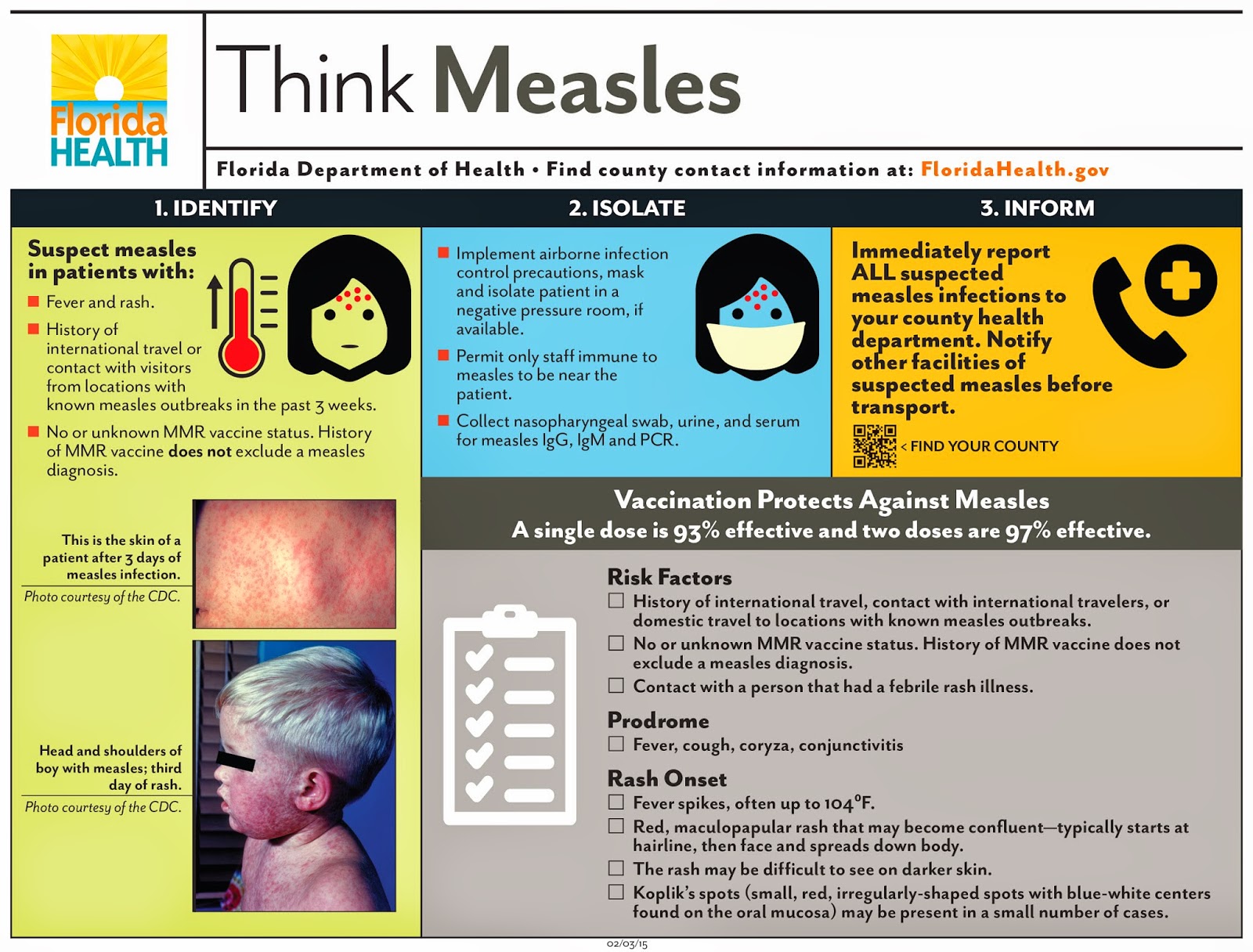
Health Officials Confirm Case of Measles in Florida


The Florida Department of Health has confirmed the state's first case of measles this year in an international traveler became ill while on a business trip.

The infected person was attending a conference in Kissimmee for two days but did not attend any theme parks. While he mainly spent time at the conference in Osceola County, he also spent time in Miami-Dade, Orange and Sarasota counties.

The traveler was hospitalized between March 20-24 in Miami and after recovery left Florida by plane on March 25. Emergency rooms in the areas that he visited during the incubation period are aware of the case and are watching for other suspected cases.

Measles is one of the most contagious communicable diseases that spreads via the respiratory/droplet route. It has resurfaced this year, with four outbreaks in 17 States and the District of Columbia, and a reported 178 people with the disease as of March 27, according to the Centers for Disease Control and Prevention (CDC). The primary case is thought to be an international traveler who visited Disneyland in California.

Parents of unvaccinated children as well as unvaccinated adults born after 1957 should be quarantined for 21 days after a known or suspected exposure to someone with measles. With the surge of cases since the beginning of the year, the push to promote vaccination, particularly in children, is in full swing.

Unfortunately, unfounded, non-scientific based information regarding childhood vaccines causing autism and other disorders has increased the exposure risk of individuals who are unable to be vaccinated for medical reasons and is resulting in the loss of community immunity.

Healthcare professionals should suspect measles in unvaccinated patients with the following signs and symptoms:
  • Fever
  • Dry cough
  • Runny nose
  • Sore throat
  • Inflamed eyes (conjunctivitis) and sensitivity to light (photophobia)
  • Tiny white spots with bluish-white centers on a red background found inside the mouth on the inner lining of the cheek — also called Koplik's spots
  • A skin rash made up of large, flat blotches that often flow into one another

Mar 19, 2015

Florida Hospital Association Reports Infection Prevention Improvement Statewide


Hospitals nationwide have been intricately involved in quality assurance performance improvement efforts (QAPI) for several years. In 2012, seventy-seven Florida hospitals, under the direction of the Florida Hospital Association (FHA), enrolled in the largest hospital quality improvement project in the state in partnership with the American Hospital Association, Centers for Medicare and Medicaid Services (CMS) and the Hospital Engagement Network (HEN). They set a goal of achieving a 40% reduction in harm and a 20% reduction in preventable readmissions within a three-year period.

The project was extensive, with hospitals working through the FHA HEN providing many resources to fulfill the requirements. The focus was placed on 11 major areas that are notoriously for having the highest reported incidences of preventable harm. Four of these areas related to healthcare-acquired infections (HAIs), including central line-associated bloodstream infection (CLABSI), catheter-associated urinary tract infection (CAUTI), surgical site infection (SSI) and ventilator-associated pneumonia (VAP).

According to a recent FHA report (pdf), results on this initiative are very encouraging thus far, and include significant improvement in reduction of HAIs. Within the 11 areas of focus, it was reported that 27,500 cases of harm were prevented. The overall harm rate was reduced by 54% and an estimated $170 million in healthcare costs were avoided.

Of note in the report is a special mention of CLABSI and CAUTI reduction: “In addition to the 11 targets, FHA HEN hospitals also worked on reducing dangerous infections such as Clostridium difficile (C. diff), Methicillin-resistant Staphylococcus Aureus (MRSA), sepsis and several other complications."

With Florida's progress toward infection prevention and eliminating patient harm, including HAIs, the state is continuing collaborative efforts as there remains much work needed to continue progress in the area of patient safety. HEN 2.0 will be launching later in 2015, with Florida hospitals striving for the ultimate goal of "safest in the country."